
KlickTech — People make the difference. AI amplifies it.

Our approach

Human intelligence.
Measurable progress.

AI creates value when it connects to real work, earns the trust of the people using it, and delivers results you can measure.

We begin with your business priorities and the experience of your people. Together, we identify where work can improve and decide whether AI is the right way to help.

Explore the Green Circle
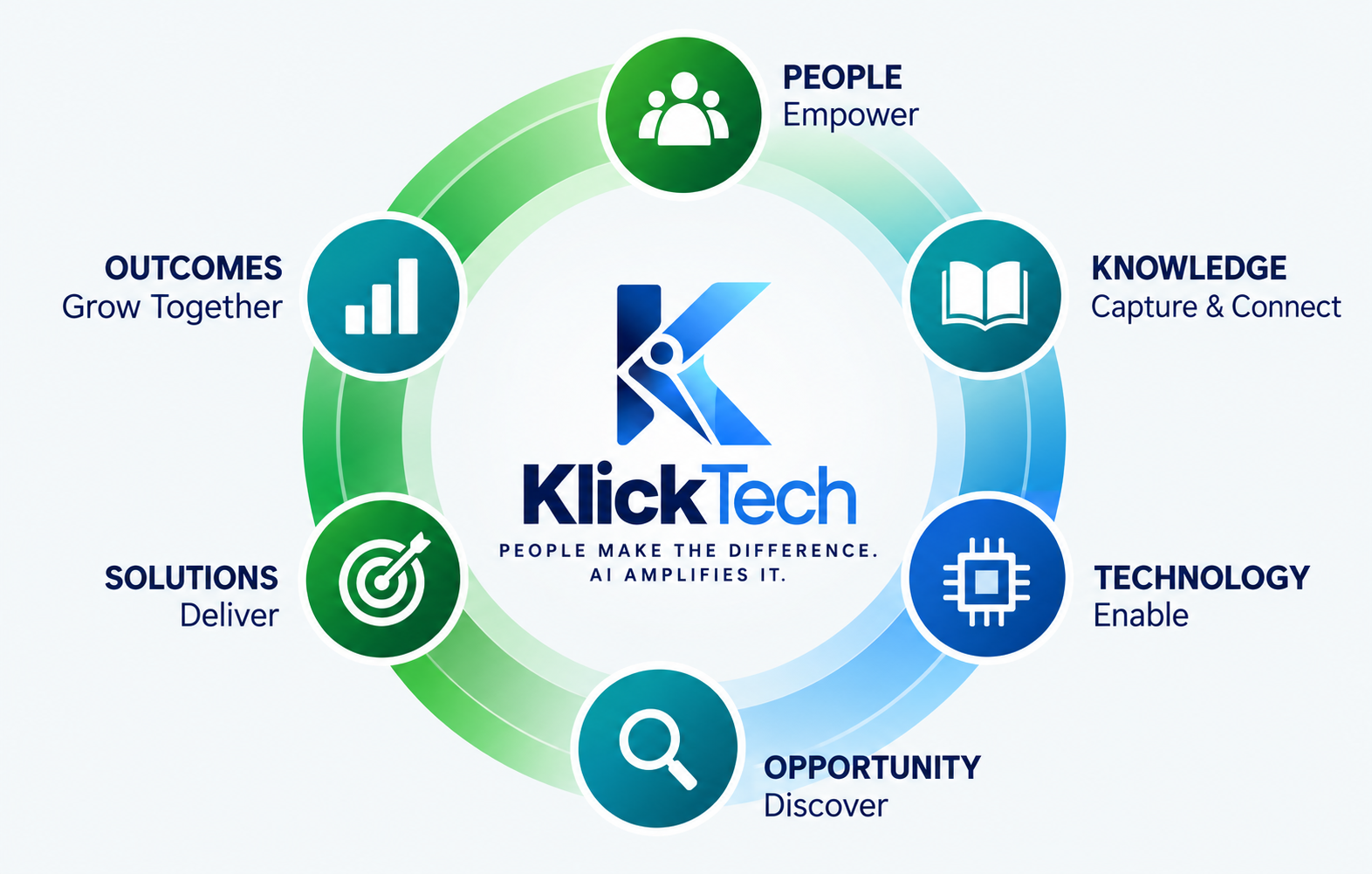
KlickTech Green Circle: People—Empower; Knowledge—Capture and Connect; Technology—Enable; Opportunity—Discover; Solutions—Deliver; Outcomes—Grow Together.
Six connected areas. One continuous cycle of improvement.

The Green Circle methodology

People make the difference at every stage.

The Green Circle connects what your people know with the tools and decisions that turn that knowledge into useful change.

Its six areas stay connected throughout an engagement. An outcome can reveal a new opportunity. A pilot can expose a knowledge gap. Employee feedback can change the solution. We use those lessons to guide the next cycle.

01 / People

Empower

The people closest to the work help shape the change.

We listen to employees and leaders, explain the purpose of the work, and invite people to identify tasks that create friction. Their experience helps us understand exceptions, customer needs, and the decisions that require human judgment.

Training and safe opportunities to experiment with approved tools help people build confidence. We make contributions visible and consider how any capacity gained can support more valuable work.

What we establish: shared priorities, employee involvement, clear responsibilities, and the support people need to participate.

02 / Knowledge

Capture & Connect

Make the experience inside your organization easier to find and use.

Useful knowledge lives in conversations, documents, systems, and everyday working habits. We examine where it sits, how people access it, and what gets lost between teams.

We identify trusted information sources, ownership, and gaps in data readiness. That gives a potential solution the business context it needs, with clear limits on access and use.

What we establish: a picture of the workflow, its information sources, and the knowledge or data gaps that need attention.

03 / Technology

Enable

Choose and connect technology around the business task.

We define the task, the information required, the expected output, and how people will use it. The right fit may involve an existing application, automation, an AI model, or a combination of tools.

Integration decisions consider approved data, access permissions, privacy, and auditability. We define boundaries for automated actions and bring in specialist expertise where the implementation needs it.

What we establish: a suitable technical approach, integration requirements, and boundaries for safe operation.

04 / Opportunity

Discover

Find improvements worth pursuing and test the assumptions behind them.

Employees can “green-circle” repetitive tasks, handoff delays, quality issues, or service problems. We connect those observations to the business outcomes that matter most.

Before committing to a solution, we assess potential value, feasibility, data readiness, and risk. We establish a baseline and agree how to tell whether the change has helped.

What we establish: a prioritized use case with success criteria and a reasoned decision about whether to proceed.

05 / Solutions

Deliver

Put a focused change into the workflow, with people ready to use it.

We start with a manageable use case and test the approach with the people doing the work. Their feedback helps refine the workflow and check important outputs before wider use.

Implementation includes training, ownership, and a plan for exceptions. Where needed, we define human approval points and a way to roll back the change.

What we establish: a tested implementation with operational ownership, user support, and appropriate controls.

06 / Outcomes

Grow Together

Use evidence to decide what happens next.

We compare results with the agreed baseline, looking at business value alongside quality, service, and the experience of the people using the solution.

Operational data, employee feedback, and business intelligence help make the result visible. We review exceptions and unintended effects, then decide whether to improve, expand, pause, or stop. Lessons from that decision feed the next cycle.

What we establish: an evidence-based review and a clear recommendation for the next step.

How an engagement runs

A repeatable delivery cycle.

The Green Circle guides our thinking. This delivery cycle organizes the work from the first conversation through review.

  1. Discover

    Understand business goals, customer needs, constraints, and current performance.

  2. Identify

    Consult the people doing the work and select candidate opportunities.

  3. Validate

    Assess value, feasibility, data readiness, and risk. Agree the baseline and success criteria.

  4. Implement

    Integrate the chosen approach into the workflow, with training and clear ownership.

  5. Measure

    Compare results with the baseline and targets using operational data and feedback.

  6. Refine & Scale

    Improve, expand, pause, or stop based on evidence and operational readiness.

Integration and responsibility

Clear boundaries.
Accountable decisions.

A useful solution needs the right business context and clear limits on what it can do.

  • Trusted information: define approved sources, access permissions, and ownership.
  • Appropriate controls: address privacy, security, retention, and audit requirements before production use.
  • Human judgment: identify which outputs need review, who approves actions, and how exceptions are handled.
  • Specialist support: involve engineering, security, legal, or domain expertise when the use case requires it.

What we measure

Progress you can examine.

We agree a balanced set of measures for the use case. Faster work is only part of the picture.

Productivity
Cycle time, throughput, cost per transaction, and time spent on repetitive tasks.
Quality
Errors, rework, consistency, completeness, and exception rates.
Service
Response time, resolution quality, customer experience, and service-level performance.
Risk & control
Policy compliance, access violations, review rates, auditability, and incidents.
Adoption & people
Training, quality of use, employee feedback, and capacity directed toward more valuable work.
Business value
Validated savings, avoided cost, capacity gained, attributable revenue contribution, and total cost of ownership.

A focused starting point

Begin with a conversation about your work.

A small, measurable use case gives us a way to test what could help your organization.

  1. What business outcome matters most right now?
  2. Which workflow or customer experience is worth examining?
  3. What data and systems support that work today?
  4. What controls and employee involvement are necessary?
  5. How will we know whether the change worked?

The next step may be to proceed, refine the idea, pause, or choose a solution that does not need AI. The decision should follow the evidence.

Let’s Talk About Your Organization

mark@klicktech.ca437-873-0129